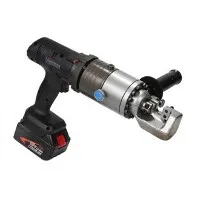

Electric hydraulic rebar bending machines offer the following significant advantages over traditional mechanical bending machines:
Strong and stable power for greater bending capacity
Electric hydraulic models: A motor drives the hydraulic pump, delivering consistent and uniform power. They can bend high-strength rebar exceeding 32mm in diameter (some models up to 40mm) without stalling or power loss, ensuring uniform force application.
Mechanical transmission models: Relying on gears or belts, their power transmission efficiency is constrained by mechanical limitations. Bending thicker rebar often causes stalling or insufficient force, necessitating frequent equipment adjustments.
Example: During shear wall capping in high-rise construction, electric hydraulic models effortlessly bend 32mm rebar, whereas mechanical models may require segmented processing, reducing efficiency.
Precise and controllable angles for high-precision construction
Electric hydraulic models: Equipped with high-precision hydraulic valves and electronic positioning systems, angle errors are minimized to ±0.5°. They support standard bends (e.g., 180° hooks) and complex shapes, meeting stringent building code requirements.
Mechanical transmission models: Using mechanical limiters, angle deviations typically range from ±1° to 2°, often requiring manual secondary adjustments to achieve accuracy.
Data support: A construction site comparison revealed 98% angle consistency for electric hydraulic bends versus 85% for mechanical models.
Easy and convenient operation, reducing labor intensityElectric hydraulic models:
Operate on standard power supplies with flexible setup options.
Feature ergonomic handles and foot switches, enabling single-user operation.
Some models incorporate intelligent controls (e.g., CNC systems) for further simplification.
Mechanical transmission models:
Require multi-person collaboration (e.g., one worker securing rebar while another operates the machine).
Complex mechanical structures demand manual angle adjustments, leading to downtime and lower efficiency.
User feedback: A construction team reported a 50% reduction in operators and a threefold increase in daily rebar processing after switching to electric hydraulic models.
Versatile and efficient, enabling "one-machine multifunctionality"Electric hydraulic models:
Handle diverse materials, including round steel, rebar, and anchor rods.
Adjust bending speed and force dynamically for varied applications (e.g., high-rise buildings, bridges, railways).
Some models combine bending and straightening functions, eliminating tool changes.
**Mechanical transmission models
Limited to specific rebar sizes with poor material adaptability.
Single-purpose design necessitates multiple machines for different tasks.
Example: In bridge projects, electric hydraulic models simultaneously bend main rebar and straighten stirrups, while mechanical models require sequential operations.
Comprehensive safety features to minimize accident risksElectric hydraulic models:
Include safety guards, emergency stop buttons, and overload protection systems that automatically halt operation under resistance or overload.
Self-lubricating hydraulic systems reduce wear and extend equipment lifespan.
Mechanical transmission models:
Lack overload protection, increasing risks of rebar jamming, equipment damage, or operator injury.
Exposed mechanical components pose additional hazards.
Accident statistics: Regional safety reports indicate a 2.3× higher accident rate for mechanical models compared to electric hydraulic alternatives.